Learning & teaching

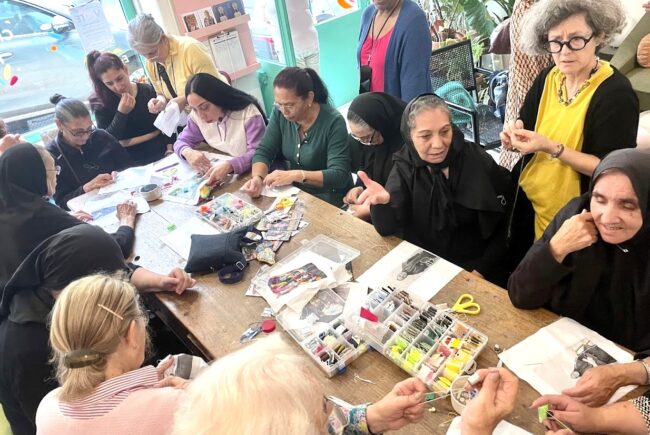
At the embroidery event, women from Grandma Came to Work and Citizens Xelerator shared and learned new skills. Launched in 2023, the Citizens Xelerator project promotes civic literacy and social empathy among adults. Photo: Citizens Xelerator.
At the embroidery event, women from Grandma Came to Work and Citizens Xelerator shared and learned new skills. Launched in 2023, the Citizens Xelerator project promotes civic literacy and social empathy among adults. Photo: Citizens Xelerator.
As Portugal faces declining support for adult education, initiatives like Citizens Xelerator are more crucial than ever. In Lisbon, women from the association Grandma Came to Work and Citizens Xelerator explored embroidery while developing civic skills and social connections.
Adult education is under threat across Europe, and Portugal is no exception. It’s not just a question of dwindling funding but also growing political resistance to lifelong learning and civic education initiatives. This is what worries Manuela Paulo, a member of the Portuguese Association for Culture and Lifelong Education (APCEP) and coordinator of the Citizens Xelerator project in Portugal.
“Governments and institutions don’t seem to recognise the value of adult education and lifelong learning. It’s difficult to persuade them to invest in innovative projects in today’s political and social climate,” she says, reflecting on the current state of adult education in Europe and in her home country.

“Governments are only willing to fund lifelong learning if it’s tied to employment. Yet personal and social skills and critical thinking are just as vital,” says Manuela Paulo, member of the Portuguese Association for Culture and Lifelong Education. Photo: Manuela Paulo.
Paulo believes this situation is particularly dangerous now, with democracy under threat, increasing social polarisation, geopolitical and economic instability and widespread disinformation.
While basic literacy has improved over the decades, functional illiteracy remains a serious issue across the continent. It’s estimated that around 40% of adults in Europe struggle to properly comprehend written texts. So, although they can read and write, the demands of modern society have evolved – leaving many behind.
Paulo explains that the situation in Portugal is especially concerning. A 2023 study Survey of Adults Skills 2023: Portugal by the Organisation for Economic Co-operation and Development (OECD) revealed that the country faces significant challenges with functional illiteracy and low literacy levels among adults aged 16 to 65, scoring below the OECD average in literacy, numeracy and adaptive problem-solving.
Notably, 42% of Portuguese adults have low literacy proficiency, meaning they struggle with basic reading tasks. Only 4% of those surveyed demonstrated high literacy levels, capable of understanding and evaluating long, complex texts and grasping nuanced meaning.
This is no minor issue. Disinformation, misinformation and malinformation have surged in recent years (Europe Press Freedom Report, 2024) and a 2023 report from the European Parliament’s special committee (Report on foreign interference in all democratic processes in the European Union) highlighted how fake news and coordinated disinformation campaigns have become tools of political interference.
The ability to process information, especially online, and to distinguish truth from falsehood is “an essential part of our democratic rights and responsibilities. Democracy strengthens adult education, and adult education strengthens democracy – they should be inseparable,” continues Paulo.
Democracy strengthens adult education, and adult education strengthens democracy.
“False information spreads at an alarming rate on social media and even in mainstream outlets. If adults can’t understand the complex society they live in or critically process the information they encounter, they can’t truly be citizens or engage in civic education. Civic participation becomes impossible in such a context.”
This is precisely why the Citizens Xelerator project was launched in January 2023. Co-funded by the European Union through the Erasmus+ programme and national governments, the initiative aims to strengthen democratic and civic literacy and foster social empathy among adult learners.
“The goal is to contribute to systemic change at regional, national and European levels, encouraging adult participation in democratic life,” says Paulo.
The project spans eight countries – Croatia, Germany, Greece, Ireland, Italy, Portugal, Romania and Spain – and involves 59 local partners.
“Over the past two years, we’ve developed a set of tools, all translated into eight languages, for adult learners to use,” says Paulo.
The first phase focused on developing a set of life competencies for learners. These LifeComp cards helped adults identify their strengths and areas for growth. The skills ranged from personal attributes like self-regulation and flexibility, to social skills such as empathy and communication, and learning skills including critical thinking and a growth mindset.
“The LifeComp Framework included nine cards,” she says. “We asked educators to create activities that validated and recognised learners’ personal and social competences, whether acquired formally, informally or non-formally.”
The team then developed the Citizens Xelerator Model and Toolkit to offer a structured approach for “supporting adults with unmet literacy needs to improve their skills and promote democratic and civic engagement in their communities. The idea was to give them the practical tools to drive the change they wanted to see,” Paulo explains.
This led to a series of workshops, both online and in-person, as well as microlearning sessions focused on specific topics.
“We covered financial, digital, sustainability, media, democratic and health literacy to help adults plan civic initiatives addressing local challenges.”
Action labs were set up in all eight countries, allowing learners to apply their newly acquired skills. One example in Portugal was an embroidery event held in Lisbon in 2024, guided by the “Create your Action!” brochure from the Citizens Xelerator project.
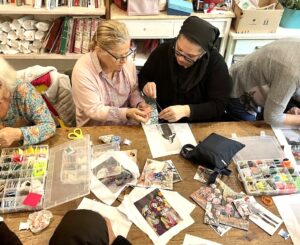
The workshop introduced self-portraiture through the fusion of embroidery and photography. While the women from the association taught embroidery techniques, the other group exhibited their own embroidery net projects. Photo: Citizens Xelerator.
The event brought together around a dozen women from the Roma community and a group of women from the association ‘A avó veio trabalhar’ (‘Grandma came to work’) to “share experiences, develop skills and promote lifelong learning,” Paulo recalls. Another goal was to build connections among the participants.
“It was a rich exchange of skills and experiences, a perfect example of lifelong learning in action.”
The project team also gathered feedback from participants in the events, many of whom said they felt more confident and curious to continue learning. Those who attended financial literacy workshops reported feeling more independent and empowered.
“We’re incredibly proud of everyone’s efforts and the results we’ve achieved,” says Paulo. The project also won the 2025 Grundtvig Award from the European Association for the Education of Adults (EAEA).
“This recognition means a lot to us. We’ve worked collectively for years and receiving a prize from a Europe-wide organisation is a huge honour,” she continues.
Yet on an organisational level of Citizens Xelerator project, it wasn’t always easy.
“Coordinating activities, tools, and materials across eight countries posed major challenges – not just language barriers, but also differing cultural, social, economic and political contexts. You can’t apply the same methods everywhere. There’s no one-size-fits-all approach,” Paulo says.
However, she believes that international cooperation is essential for progress, open-mindedness and for the exchange of diverse perspectives and ideas.
“But in order to do this, we need well-trained educators and a political system that supports the field,” concludes Paulo.
Despite the success, the project concluded at the end of 2024 after two years, and Paulo is not optimistic about its continuation. The political climate in Europe isn’t supportive of adult education and lifelong learning. Governments and institutions are cutting funding and there’s also a cultural resistance.
“It’s not just about money. Politicians don’t seem to see the value in adult education; they don’t think it’s useful. In Portugal and elsewhere, the focus has shifted solely to work-related skills for adults, as if that’s the only issue. But we need a holistic investment in lifelong learning.”
Uncertainty around political decisions also makes long-term planning difficult.
“From what we’ve seen across Europe, governments are only willing to fund lifelong learning if it’s tied to employment. Other types of training, like civic education and democracy-building, are overlooked,” says Paulo. “Yet personal and social skills, learning to learn, self-reflection and critical thinking are just as vital.”
“Adult education is becoming extinct in Portugal,” Paulo warns, citing the dismantling of the National Agency for Qualification and Vocational Education (ANQEP) in July 2025.
She doesn’t believe the project will continue at the same scale. “We’ll probably manage some smaller national projects, but I doubt we can maintain international cooperation,” she says.

This article is part of the theme 'Adult Education and Democracy 2025'.
Read related articles here