Policy perspectives

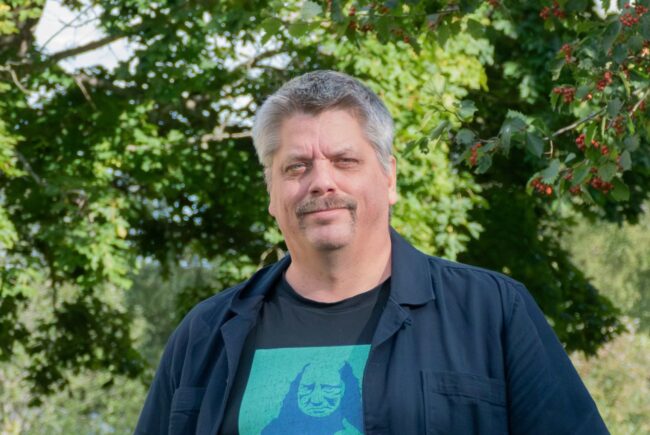
“In folk high schools, teachers help learners put broad knowledge into context. This is important for discussions that underpin democracy and the mesh of society,” says Tomas Rosengren, President of the Folk High School section of the Swedish Teachers’ Union. Photo: Emma Förste.
“In folk high schools, teachers help learners put broad knowledge into context. This is important for discussions that underpin democracy and the mesh of society,” says Tomas Rosengren, President of the Folk High School section of the Swedish Teachers’ Union. Photo: Emma Förste.
Non-formal adult education has played a crucial role in strengthening societal resilience in the Nordic countries – and is now more essential than ever, says Tomas Rosengren of the Swedish Teachers’ Union. In his view, teachers’ most important role is to help learners see the broader context of any subject.
Folk high schools have been a keystone in building the Nordic democratic tradition and still have a vital role as civil society begins to splinter and fray, according to Tomas Rosengren, President of the Folk High School section of the Swedish Teachers’ Union.
“The resilience and strong civil society we have – or at least have had – in Sweden, is built on the traditionally strong connection between a well-organised community life and popular education in the form of folk high schools and study associations. This is what we call the Nordic model,” says Rosengren.
He points to nineteenth-century visionaries such as NFS Grundtvig (1783–1872), a Danish pastor, writer, philosopher, historian, teacher and politician.
“Folk high schools emerged at a time when the Nordic countries were moving towards democratisation,” Rosengren explains. “Wise people such as Grundtvig realised that tools were needed to help more people to understand civil rights as well as other aspects of democracy such as listening, comprehension and taking a stand. Previously, that had been the privilege of the elite, who also had access to power.”
Rosengren points out that folk high schools have important connections to the popular movement, including many grassroots social movements that began in the nineteenth century. These included business cooperatives and sports associations as well as groups centred on the needs and rights of women, youth and workers, including their education.
“Folk high schools have since been a complement to the rest of the education system in the Nordic countries, but also a prerequisite for many higher education courses, not least in the cultural sector,” says Rosengren.
“A very large proportion of those studying at Swedish universities with a cultural focus, such as art, theatre and music, have laid the foundation with one or more years at one of the folk high schools with similar focus. The colleges themselves say that the folk high schools are a prerequisite for them to be able to admit students with the right qualifications. The folk high school courses have such a reputation that they are seen as, in principle, a formal background,” he explains.
In general, learners can gain eligibility for higher education through a combination of 1-3 years at a folk high school, passing a certain number of upper secondary school subjects and work experience.
“Even though in Sweden you can study formal qualifications for university studies at folk high schools, we at folk high schools work in a more cross-disciplinary pedagogical way,” he says, citing fundamental differences between folk high schools and other schools.
We at folk high schools work in a more cross-disciplinary pedagogical way.
“Part of our pedagogical approach is not concentrating on subject knowledge, as is perhaps the case in the regular school system. We constantly try to talk about context and help our course participants to learn to see context as the most important thing to understand. Then it’s easier to absorb the facts you need to complete your life tasks,” says Rosengren, who has taught at a folk high school near Umeå, northern Sweden, for two decades.
There, he says, teachers strive to create contexts rather than just preparing students to be examined in each individual subject, as in traditional schools.
“The knowledge of the hand is very much connected to the mind and we try to mix them. If you go to a folk high school to learn woodcraft, we can combine that with talking about the development of the wood industry or history of woodcraft, for example, and sometimes you can do it simultaneously,” he says.
“Compared to the role of a teacher in a traditional school, I’d like to believe that we function more as conversation leaders,” Rosengren suggests. “Even though I may start the day with a lecture, I want to talk about it with the participants afterwards. Only then can I see if they have understood and can put it into context.”
What is most important to enable teachers to play this crucial role?
“At a folk high school, a teacher needs three things: time, good colleagues and groups of participants that aren’t too large,” Rosengren replies.
Even with such optimal teaching prerequisites, today’s adult education teachers face unprecedented challenges due to deep-seated changes in society and human interaction.
The Nordic adult education model has long been a motor of societal resilience, egalitarianism and democracy in Sweden and its neighbours, he says – but warns of worrying changes.
“I think it may have created a positive inertia that has made it more difficult for anti-democratic forces to gain a foothold in the Nordic context… until now. Here in Sweden, for example, we’ve seen a long-term decline in people’s engagement with non-profit groups and NGOs. The fewer people get involved in different boards and associations, the harder it is to find a coach for the kids’ volleyball team. That’s all part of the democratic infrastructure. So that undercuts the basis of democracy and opens up room for populism,” says Rosengren.
A decline in people’s engagement with non-profit groups and NGOs undercuts the basis of democracy and opens up room for populism.
When asked how the need for societal resilience is changing, and what factors are involved, he specifies a fundamental shift in interpersonal communications.
“It’s hard not to talk about social media in a context like this. People don’t talk to each other to the same extent anymore, but more about each other, preferably at arm’s length, which the digital sphere provides.”
To counter this, he argues that “we have to find new forums to create opportunities for conversation. I believe that the lack of conversation is the big challenge. The need for conversation exists, but awareness of that need is the challenge.”
So can education in general help to strengthen society’s collective resilience?
“Education hopefully means knowledge, and that’s one of the important tools you need to question something,” says Rosengren.
However, in his view, one of today’s major challenges is “a changed view of knowledge, not least from a political perspective. Knowledge is something that should be measured and weighed, preferably by subject, and above all it should be useful to society.”
“We at folk high schools know that our view of knowledge, which is based on broad knowledge put into context, is actually very useful to society.”
Seeing the broader context is also an important prerequisite for working life, but also for the genuine person-to-person discussions that underpin democracy and the mesh of society.
“If you can look up and see that reality is not divided into subjects, you’ll function better in professional life. But above all, you’ll also become a community builder who enjoys talking to people around you,” says Rosengren.
To explore further, watch a video related to this article. In the video, Tomas Rosengren explains how non-formal adult education offered in folk high schools contributes to societal resilience.
This article is part of the theme ‘Adult Education and Resilience 2026’.
Read related articles here