Learning & teaching

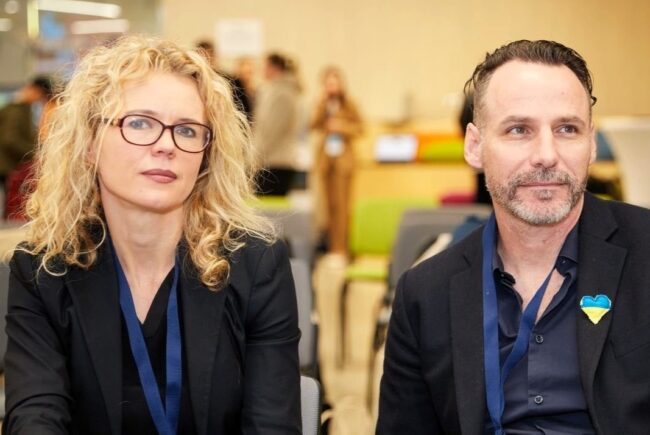
Tetyana Hoggan-Kloubert and Chad Hoggan argue that lifelong civic learning should cultivate the ability to live by the principles of autonomy, solidarity, rationality and pluralism, while navigating the tensions that arise between them. Photo: Yuriy Petrushenko.
Tetyana Hoggan-Kloubert and Chad Hoggan argue that lifelong civic learning should cultivate the ability to live by the principles of autonomy, solidarity, rationality and pluralism, while navigating the tensions that arise between them. Photo: Yuriy Petrushenko.
“We see a danger of democracy collapsing, and the need for a new framework for adult civic learning to respond to it,” say Tetyana Hoggan-Kloubert and Chad Hoggan, authors of the new book Learning for Democracy: A Framework for Adult Civic Learning.
Chad Hoggan, Professor of Adult & Lifelong Education at North Carolina State University in the US, and Tetyana Hoggan-Kloubert, Akademische Rätin (Associate Professor) of Adult and Continuing Education at the University of Augsburg, Germany, raise the alarm about threats to democracy in the US, Europe and elsewhere in Learning for Democracy: A Framework for Adult Civic Learning, published in November 2025.
The book proposes a new type of framework for adult civic learning “rooted in the foundational value of human dignity as the rationale for democracy. That’s also the gauge by which we assess whether behaviours are supportive of democracy,” explains Hoggan-Kloubert.
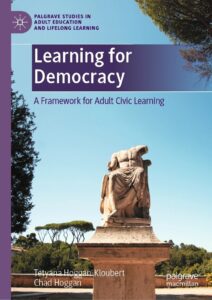
In their book, Tetyana Hoggan-Kloubert and Chad Hoggan offer a new framework for civic learning that would equip citizens for effective, principle-guided participation in democracies.
The writers urge a shift in lifelong learning based on four time-tested principles that guide behaviour: autonomy, solidarity, rationality and pluralism.
Lifelong civic learning should cultivate the capacity to live out these principles in daily life – and to navigate the tensions that inevitably arise between them, the authors argue. This approach, they say, aims to equip citizens for effective, principle-guided participation in democracies.
In their view, civic learning should move towards a principle-oriented, lifelong approach, based on those four core democratic principles.
“This also means designing learning environments that embody these principles, where people can practice democratic habits in everyday life,” says Hoggan-Kloubert. “We must learn to negotiate differences, act in solidarity, and, when necessary, stand up to defend the democratic space itself.”
In Learning for Democracy, Hoggan-Kloubert and Hoggan point to the eighteenth-century Age of Enlightenment in Europe and North America as the source of these four basic principles, calling for them to be updated and defended today.
“For example, we argue for reclaiming rationality in its richer, dialogical form – as public reason, exercised collectively in civic spaces,” says Hoggan. “This form of rationality is inherently interactive. It requires dialogue and mutual justification, and being open to correction and critical discussion – with empathy.”
We argue for reclaiming rationality in its dialogical form as public reason, exercised collectively in civic spaces.
Another Enlightenment-era concept that they stress is autonomy, which they define as respect for each human being as capable of thinking and acting for themselves. That’s in contrast to heteronomy, rules imposed from outside, justified by the belief that some have the right to mould others into a certain worldview or ideology.
“In pedagogical situations, that means respecting the autonomy of every other person. And that implies the prohibition of indoctrination – putting ideas and ideology above a human being, or considering a human being as possible or acceptable ‘collateral damage’ on the way to pursue however-designed visions,” says Hoggan.
He and Hoggan-Kloubert note that these four principles entail inevitable tensions: between solidarity and autonomy, and between rationality and pluralism.
“Citizens need to be able to navigate these tensions,” says Hoggan-Kloubert. “Specifically, they need advanced capacities for rational assessment and critical thinking to evaluate complex issues and the counter-manipulation, misinformation and propaganda that are rife in this polarised public discourse. They also need skills in perspective-taking, active listening and critical self-reflection. These are all important for fostering pluralism and avoiding ideological echo chambers.”
In short, civic skills are more crucial now than ever, they stress.
“The current crises underscore the urgent need to reimagine civic learning,” says Hoggan-Kloubert.
Hoggan agrees, adding that “if democracy is taken for granted, we risk its demise”. He cites critical skills such as being able to engage in reasoned deliberation and collective action, to evaluate arguments against misinformation and propaganda, to enlarge spaces for discussion, and to cultivate a strong feeling of solidarity beyond tribalism – in short, “taking part in responsibility for the world”.
If democracy is taken for granted, we risk its demise.
“We must ensure that we remain open to diverse, non-homogeneous views while insisting on evidence and justification,” he says. “But we must also be able to recognise and work against authoritarian tendencies.”
The resurgence of nationalist and authoritarian movements is just one of the dangerous challenges to democracy today around the world, notes Hoggan.
“Another is the increasing polarisation of political discourse, which is often amplified by echo chambers and intentional manipulation,” he says.
One of the biggest challenges he sees is the renouncement of dialogues across differences. “We should be able to ask each other questions like, ‘why you think the way you do? What are your reasons for seeing the world this way?’ – and we must be ready to answer these questions ourselves.”
Being ready to have these sometimes-difficult dialogues despite our differences means having a commitment to search for truth together, he adds.
Readiness to have dialogues despite differences means having a commitment to searching for truth together.
“That may never be fully achievable, but it’s still possible to approach this step by step, as opposed to staying in one’s own echo chambers, clinging to ‘my own truth’ and refusing to talk together.”
Another big challenge the authors see is a loss of solidarity and a rise in harmful tribalism.
“This is expressed in slogans like ‘Make America Great Again’ or ‘Make Czechia Great Again’,” says Hoggan-Kloubert. “Underlying that is a loss of the feeling of being accountable, touched and concerned by the fate of other human beings beyond one’s own tribe or nation.”
That feeling, she says, was summed up by Czech author and president Václav Havel in 1997, when he wrote that “there is, in every one of us, a small feeling of responsibility for the world and for its future”.
Hoggan has a grim assessment of the current situation in his home country, but hope for a brighter future.
“The current context in the US is characterised by the severe decline of valuing democracy. We do see a danger of democracy collapsing,” says Hoggan bluntly.
“The future trajectory we hope for is one of renewed civic imagination – a reinvention of civic learning that cultivates active, solidaric and pluralistic citizenship, and one that directly confronts growing authoritarianism and polarisation.”
He also expresses concern about a nationalist trend within the US educational establishment.
“We see some educational authorities aiming to promote civic knowledge in the sense of patriotism. At first glance, there might be nothing wrong with this, but we observed the same tendency in Russia 20 years ago: civic education was replaced by patriotic education, and then by military education, with an anti-humanistic version aiming at tribalism, obedience, passivity and blindness to the suffering of others,” he says.
Russia’s aggression against Ukraine and other territorial wars are among the key challenges facing contemporary democracy, says Hoggan-Kloubert. Others include the formation of global authoritarian coalitions of anti-democratic states, as described in American-Polish journalist and historian Anne Applebaum’s 2024 book Autocracy, Inc.: The Dictators Who Want to Run the World, she says, as well as “the conviction among citizens that they can’t influence the worlds they are living in, which results in passivity, apathy and frustration”.
In her view, these crises “demand an active, conscious and collective effort to reimagine the citizen as a co-creator with a commitment to certain principles”.
We need a collective effort to reimagine the citizen as a co-creator with a commitment to certain principles.
She sees worrying parallels between the current climates in the US and Europe.
“The situation in Europe is also, to a certain degree, characterised by weakening democratic institutions, declining commitment to democracy, and rising polarisation between the populist right and the extreme left,” says Hoggan-Kloubert. “Some European states are specifically identified as illiberal democracies, and their number is growing.”
“Some civic learning traditions are rooted in neutrality, but now is not the time to be neutral toward positions that go beyond the human horizon, in other words, that violate human dignity,” she asserts. “At the same time, we must try to keep a commitment to the most pluralistically possible world. We must learn to endure positions that aren’t compatible with our own, but which still honour human dignity.”

This article is part of the theme 'Adult Education and Democracy 2025'.
Read related articles here