Policy perspectives

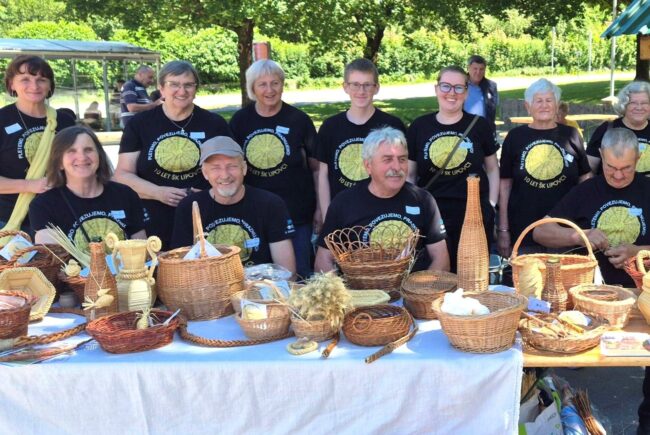
An active study circle has been operating in the village of Lipovci since 2016. Members teach traditional basketweaving to newcomers while creating opportunities for socialising. In June 2026, circle members presented their work at a meeting of Slovenian study circles in Pivka. Photo: Ema Meden.
An active study circle has been operating in the village of Lipovci since 2016. Members teach traditional basketweaving to newcomers while creating opportunities for socialising. In June 2026, circle members presented their work at a meeting of Slovenian study circles in Pivka. Photo: Ema Meden.
Slovenian villagers are reviving the nearly lost art of basketweaving – and, through learning together, strengthening social ties. They are weaving community bonds through a programme run by a local adult education university.
“I think our mentoring is a major achievement. Each of us experienced study circle members teach at least one new participant how to weave their first basket every year. We’ve learned to be teachers,” says Anton “Tonček” Pavlinjek. He’s a founding member of the Lipovci Study Circle in northeastern Slovenia.
The basket-weaving group celebrates its 10th anniversary in 2026 in Lipovci, a village with about 1,000 residents near the Austrian and Hungarian borders. The circle was set up as an initiative of the nearby University for Adult Education Murska Sobota, which has been organising study circles since 1994, soon after they were introduced by the Slovenian Adult Education Centre.
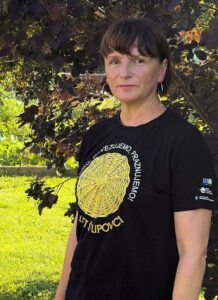
“Relationships within a circle are relaxed, and there is no hierarchy,” says Alenka Kučan. Photo: Danilo Lah.
“As a form of non-formal education, they’re very popular because they bring together people with similar aspirations and interests,” says Alenka Kučan, an adult educator at Murska Sobota who mentors study circles.
A small group led by a qualified mentor can explore specific fields, acquire new skills, deepen existing knowledge and connect tradition with the modern world in any topic of their choice – all while enriching themselves, their local community, and society as a whole through their learning, she says.
In her view, study circles are an excellent example of community-based education. They arise from the needs of the local community and can effectively address social, environmental and other problems identified in the community.
Study circles provide opportunities for socialising, thereby combating the enemy of modern society: loneliness.
“Study circles are small, typically consisting of up to 15 participants. Relationships within a study circle are relaxed and friendly. There is no hierarchy, and all participants are equals. The participants plan and decide for themselves what, when, where and how they will learn. Work in study circles is creative and collaborative,” says Kučan.
Since the participants themselves determine the dynamics, paths and goals of their learning, this is the most appealing and suitable form of education for many, she observes.
“Curious people need challenges. At the same time, study circles also provide opportunities for socialising, thereby combating the enemy of modern society: loneliness,” Kučan adds.
Slovenia, an EU nation of just over two million people in Central Europe, has one of Europe’s lowest retirement ages, with most eligible for pensions at age 60-62.
The Lipovci Study Circle began in response to the educational and social needs of older men in the area, discovered through informal conversations.
“At that time, we at the University for Adult Education Murska Sobota were striving to increase men’s participation in lifelong learning and seeking appropriate methods, learning formats, and content that would attract men to learning,” notes Kučan.
This led to the idea of forming a predominantly male study group that would bring together participants from the area around a traditionally male-dominated local craft: willow weaving. According to Kučan, local men have woven with willow wicker since time immemorial, and their descendants wanted to revive this craft.
The group’s first informal teacher was Jožef “Joži” Horvat, who was asked if he could pass on his knowledge to others.
“So, I thought, ‘Well, my dad and I still do some basket weaving, and I have plenty of time now during the winter to show them a little’. And now I’m teaching them, and I’ve been in the study circle for 10 years,” Horvat says with a laugh.
“There were several of us who used to know how to do it, but we’d forgotten. So we got started back in 2016,” recalls Marjan Mlinarič, another founding member.
We strove to increase men’s participation in lifelong learning.
“I thought the idea was excellent from the start. Here in Lipovci, there have always been skilled basket weavers. I thought we could have some workshops so we could learn – or remember – how to weave,” says Pavlinjek.
In addition to baskets, they make items such as lampshades, trivets and trays, as well as traditional braided whips. They also weave covers for bottles, most often for wine or homemade brandy. Most items are given away as gifts.
Within the community, club members also work to raise awareness of the importance of habitat conservation and the use of natural materials. At various events, they teach people how to weave fences and supports for plants in the garden.
Group members take part in many events, fairs, and workshops and demonstrate how to weave baskets at schools and preschools and raise children’s awareness.
“We explain why baskets were once indispensable in the home and how beneficial it would be if we still used them today instead of the plastic containers and bags we’ve come to rely on,” says Horvat.
The circle participates in many events, including Lifelong Learning Weeks, European Cultural Heritage Weeks, local craft fairs and the Festival for the Third Age in Ljubljana, Europe’s largest event for older people.
Over the past four years, the circle also has been running educational workshops, which Kučan describes as “truly special”.
“During these two-week workshops, we open the study circle’s doors to 8-10 interested people and teach them how to weave baskets. Our circle members become mentors, teaching and guiding their students toward creating their first woven piece,” she explains.
“We’re very proud when our students make their first woven basket,” says Horvat.
The circle has also published a brochure with weaving instructions, which was adapted into an online version to mark the group’s tenth anniversary, accompanied by a photo exhibition.
“Another achievement was our event ‘We Weave, We Connect, We Celebrate’, which drew more than 100 visitors in May 2026. To mark the anniversary, we created an outdoor woven art installation and planted 20 new willow trees,” says Mlinarič.
“We’re also recognised by handicraft and tourism organisations,” says Brigita Smodiš, who joined the circle later. “For example, the Pomelaj Rural Development Cooperative let us cut branches from an American willow tree; we returned the favour by helping them husk corn; then they invited us back to learn how to weave with corn husks.”
“And we’re not just reviving handicrafts – our social gatherings are like they used to be in the village,” she says.
That social and community-building aspect is crucial.
We’re not just reviving handicrafts – our social gatherings are like they used to be in the village.
“We feel good when we’re together. We can’t do without our study circle anymore,” says Mlinarič.
“It seems to me that we meet more and more often,” says Štefan Koren, a co-founder of the group. “We’re always looking for a reason to get together, since we enjoy each other’s company. Sometimes we make things on our own at home and then bring them in to show everyone and talk about how we made them.”
Depending on the season, the group meets up to three or four times a week at the Lipovci Village Hall.
“We often hold our meetings at our home, too, or in the backyard when the weather permits,” says Smodiš. “In our home workshop, we cook, peel, and preparing willow twigs for weaving. We also have meetings in the summer in the shade of our arbour.”
Community-building also includes networking at the national level.
In June 2026, circle members took part in a meeting of Slovenian study circles known as the Study Circle Caravan, organised this year in Pivka, southeast Slovenia.
“We were well received thanks to our large group and the unique products we exhibited. We presented the story of our circle in our own dialect, forged new connections and got new ideas for our work in the coming year,” says Kučan.
The Slovenian Adult Education Centre has arranged 12 such Caravans since 2002, showcasing the range of study circles. Their community learning focuses include a variety of topics, says Kučan.
“From exploring and preserving cultural and natural heritage, places, phenomena and the lives of famous and lesser-known people, to creative work, art, knitting, embroidery, and numerous other crafts, reading, gardening and self-sufficiency – there’s no end to curiosity!”
“I think our mentoring is a major achievement. We’ve learned to be teachers,” says Anton Pavlinjek, a founding member of the study circle. Photo: Alenka Kučan.
“We also explain why it would be good to use the baskets instead of the plastic containers and bags,” says Jožef Horvat, the group’s first teacher. Photo: Alenka Kučan.
“We’re not just reviving handicrafts – our social gatherings are now like they used to be in the village,” says Brigita Smodiš. Photo: Alenka Kučan.
This article is part of the theme ‘Community-Based Learning 2026’.
Read related articles here