New perspectives

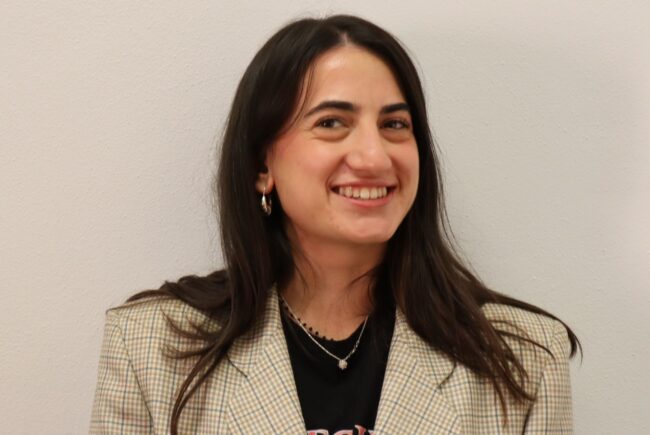
“I am passionate about the digital transformation of training contexts and about exploring how digital cultural mediators can foster professionally meaningful learning,” says Margherita Pina, a Research Fellow at the University of Macerata in Italy. Photo: Andrea Capone.
“I am passionate about the digital transformation of training contexts and about exploring how digital cultural mediators can foster professionally meaningful learning,” says Margherita Pina, a Research Fellow at the University of Macerata in Italy. Photo: Andrea Capone.
“Digital tools can transform education into an immersive, engaging and inclusive experience,” says Margherita Pina of the University of Macerata. The ELM series “Young Voices” highlights the perspectives of the next generation shaping adult education across Europe.
Margherita Pina, a Research Fellow at the University of Macerata in Italy, is exploring how AI can be integrated into university academic settings and Teaching and Learning Centres (TLC). She became interested in studying technological tools in education because, in her own words, they need “to be ‘humanised’ through the lens of the human-AI relationship, transforming them into effective tools for collaboration and learning.”
After completing my master’s degree, I had the opportunity to collaborate with the Research Centre on Education, Media, Innovation and Technology (CREMIT) at the Catholic University of Milan. There, I became involved in the field of research and teacher training, particularly for primary and secondary school teachers.
At first, I managed the organisational and administrative aspects of training courses, and later I moved on to designing and conducting training programs on digital education, podcasting and artificial intelligence.
Today, I’m beginning a new chapter: I’ve been awarded a PhD in Teaching & Learning Sciences at the University of Macerata, where I will focus on integrating AI into university academic settings and Teaching and Learning Centres (TLC).
My interest began during my undergraduate internship in Educational Sciences at Choralia, a company specialising in training, coaching and gamification. There, I discovered the value of learning in professional contexts and how crucial it is to promote collaboration within teams.
One of the most meaningful experiences was using the video game Among Us in training programs to foster cooperation and communication. That experience helped me realise the potential of technology as a tool to facilitate learning and relationships in adult contexts.
I am particularly passionate about the digital transformation of training contexts. I’m interested in exploring the potential of digital cultural mediators and their ability to foster authentic, responsible and professionally meaningful learning processes, especially for teachers.
I believe in the possibility of empowering every professional to become more autonomous and competent through the development of strong professional mastery – one that integrates knowledge and skills in a conscious and reflective way.
I would like to help develop a culture of educational consulting that promotes the conscious integration of digital tools in adult learning, especially in schools. It’s essential to move from simply knowing to being reflective and critical professionals.
The goal is to help adults understand the meaning of technological innovation, assessing its benefits and limitations for a truly meaningful use.
Adult education should be seen as an empathetic form of support for professionals who often feel disoriented by change. It’s important to create learning environments that bridge generational gaps and help build an updated, personalised “toolbox” capable of responding to contemporary challenges.
Anyone training adults must have first-hand experience in the context where they operate. In my case, working in schools for three years was essential to understanding teachers’ real needs.
Beyond technical expertise, I believe that active listening, the ability to value participants’ experiences, and guiding groups toward shared reflection are fundamental. More than transmitting information, the key is to facilitate authentic learning processes.
Adult education is a space for care and transformation, where change is not always immediate or measurable but deeply meaningful.
Educating adults means offering them an environment where professional doubts can be welcomed and reworked. Learning can happen simply through presence and support, while respecting individual rhythms and needs.
Adult education is a space for transformation, where change is not always immediate or measurable but deeply meaningful.
As Descartes said, “Cogito, ergo sum” – it is precisely through doubt that critical thinking and growth begin. It’s like the metaphor of the fish by David Foster Wallace: the fish doesn’t know what water is until someone points it out. We are so immersed in our environment that we don’t notice it until critical thinking allows us to truly see it.
In this sense, adult education is not just a learning process but a profoundly human and social act: it fosters awareness, gives meaning to experience and builds connections, restoring value to both the individual and the community.
The ELM series “Young Voices” highlights the perspectives of the next generation shaping adult education across Europe.