Learning & teaching

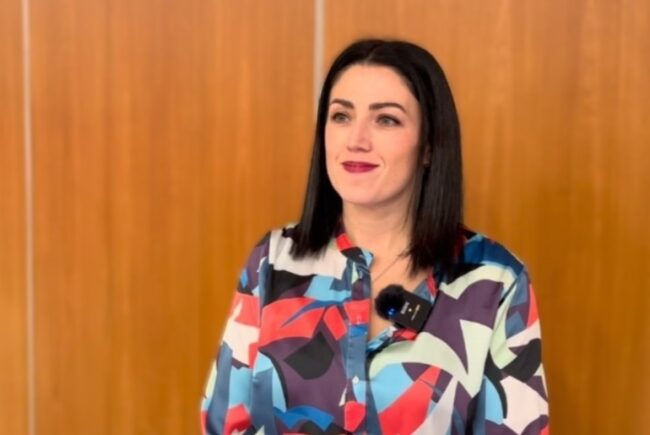
“Critical pedagogy can help people recognize harmful external factors and work together for positive change. That’s the most powerful tool we have for protecting the very fabric of a democratic, inclusive society,” says Dearbháil Lawless, CEO of AONTAS. Photo: Kvs.
“Critical pedagogy can help people recognize harmful external factors and work together for positive change. That’s the most powerful tool we have for protecting the very fabric of a democratic, inclusive society,” says Dearbháil Lawless, CEO of AONTAS. Photo: Kvs.
The learner’s voice must be the central guide in non-formal adult education as it aims to bolster societal resilience, says Dearbháil Lawless. She leads Ireland’s National Adult Learning Organisation (AONTAS), which embeds adult learners’ voices into every stage of its activities.
Non-formal adult education has a pivotal role in reinforcing Europe’s collective resilience, and the Irish experience can offer lessons in this regard, suggests Dearbháil Lawless, CEO of AONTAS, Ireland’s National Adult Learning Organisation.
Two mutually supportive areas of strength are: listening to learners’ voices and strengthening government focus on community education.
“Like any country, we have our strengths and weaknesses. But by listening to people in adult learning, we remember why this space is vital. We see the impact it has on people and their communities,” says Lawless.
In her experience, listening to what learners have to say not only provides much-needed data for policy development, “it also helps us at AONTAS to stay motivated and remember the people and their stories.”
Focusing on the needs, wishes and experiences of informal adult learners has also helped gain decision-makers’ support for community education, she says, “because the people who are supposedly ‘hard to reach’ are very visible in these adult education centres”.
Listening to adult learners reminds us why this space matters. It shows its impact on individuals and communities.
And while many of these learners face adversity, “they go through a healing journey as part of their learning and develop further resilience,” she says.
This, in turn, has a significant impact in meeting policy goals for equality and inclusion.
“By listening to learners, and getting those in power to listen to learners, we can showcase the power of adult education and the need for holistic, diverse programmes, including non-formal education,” Lawless explains.
Picking up on the links between adversity and resilience, Lawless calls for a closer examination of what we mean by societal resilience.
“It’s important for everyone to build coping mechanisms, to be able to understand and cope with change, to learn from situations and move forward with newfound knowledge,” says Lawless. “But some people also develop forced resilience because they face adversity in their lives – for example, growing up in poverty or dealing with sexism or racism.”
This is often due to institutional misrecognition, in which individuals or groups are denied proper acknowledgment of their identity or value, which she sees as common in school systems.
Some develop forced resilience due to adversity in their lives, such as poverty or racism.
“Traditional education providers are often designed to suit the majority and maintain the status quo,” Lawless asserts. “In these situations, people can be left behind or fall through the cracks. They may be seen as having personal failures, instead of policies or practices being changed to improve the situation.”
This, she argues, is where non-formal education has a crucial role: “Much of this provision takes place in settings like community centres or adult-education specific spaces that intentionally use change-oriented practices – I hope!”
In Ireland, such spaces typically have staff who place just as much focus on care and relationship-building as on curriculum delivery.
“Care is part of the pedagogy. Through non-formal adult education, we can help people to see the value of community, of building trust, making genuine human connections, and helping people to work together. I think this is vital in the times we’re living in,” says Lawless.
Non-formal adult education helps people value community and the building of trust.
“Critical pedagogy can also help people to recognise structural barriers and external factors that cause harm and support them in finding solutions and creating positive change together. I genuinely believe that’s the most powerful tool we have for protecting the very fabric of a democratic, inclusive society,” she goes on to say.
Such programmes can be flexible, rapid in response, and suited to the needs of different contexts.
“While accredited education is incredibly important, it is non-formal adult education that will build collective resilience for the future,” she declares.
Lawless cites examples of how adult learners in Ireland have experienced strengthening of their personal and collective resilience.
AONTAS worked with community education groups to deliver voter education in partnership with the Dublin Adult Learning Centre (DALC). This ‘train-the trainer’ style model provided resources and core learning on Ireland’s voting system and democracy. Educators delivered sessions locally to suit the context and learners’ needs.
“This increased personal understanding and brought higher voting in communities with historically low turnout. Because of this collective action, we also saw politicians start to take notice of people in areas that have been marginalised.”
Collective action has drawn politicians’ attention to marginalised areas.
For example, after years of requests, Belmayne Community Group on Dublin’s northern edge finally received a funding grant in 2025 for local social, cultural and recreational resources.
“A huge part of this was thanks to the learners and local volunteers who took action following their engagement in the programme,” says Lawless.
One of these is Michelle McGoldrick, a volunteer with the Belmayne Community Group. Lawless describes her as “a shining example of a learner representative who experienced the transformative power of community education and has become a local leader. She’s told me how education changed her life. Now she’s harnessing this to improve the conditions with local people in their community.”
AONTAS has a reputation for including the adult learner’s voice at all stages in its operations.
“Learner Voice is at the heart of our work. That means learners must have a say in decisions about their own education. It’s a democratic practice that should be a core part of education provision internationally. You’ll always hear from learners at our events, and we have learner representatives on our board of directors,” notes Lawless.
“Learners are the most important stakeholders in education. In Ireland, we’re fortunate that our government recognise and support this.”
Learners are the most important stakeholders in education.
For example, the State Agency for Further Education and Training (SOLAS) funds the National FET Learner Forum. In this project, AONTAS partners with regional Education and Training Boards to meet face-to-face with learners across the country and listen to their experiences. AONTAS also conducts surveys to gather wider input that is presented in its annual report, which “helps inform our understanding of what’s going well and what could be improved,” she says.
Meanwhile, AONTAS is National Coordinator for the New European Agenda for Adult Learning and hosts the ‘Learners As Leaders programme. This non-formal change-oriented model aims to help people to become leaders and representatives. Participants have become campaign spokespeople, engaged in national consultations, and led local community projects such as the Belmayne voter education drive.
Looking toward the years to come, though, Lawless is worried about adult learning’s role in building societal resilience.
“I have concerns about the future of non-formal education due to shortsighted policy goals that prioritise labour market and associated skills. Employment is incredibly important, but we must think long-term and remember the basics: healthy, happy and connected people thrive, and so our societies and economies thrive. But if we don’t fund non-formal education programmes and prioritise adult education more broadly, we risk losing our greatest tool for addressing social justice issues,” she says.
Employment is important, but healthy and connected people are the foundation of thriving societies and economies.
“We need genuine, meaningful opportunities that give people the space to think critically, to build relationships, and to work together to find solutions. This will get lost if educators are forced to focus on accredited provision and the labour market in order to keep their doors open.”
“Yet we can and should have hope,” she emphasises, nodding to the European Association for the Education of Adults, the Nordic folk high school associations, the Finnish Lifelong Learning Foundation and other groups “that continue to advocate for non-formal education and develop the expertise of educators in this space”.
In conclusion, Lawless looks to the long history of adult learning and declares that “we’re very lucky to have incredibly motivated and passionate people working in this field who go above and beyond to protect its future. We just need to work together and remind those in power to keep adult learning on their agenda.”
To explore further, view the videos related to this article:
In video 1, Derbháil Lawless talks about how non-formal adult education contributes to stronger, more resilient society in Ireland.
In video 2, Derbháil Lawless discusses how the learners have experienced the non-formal adult education in strengthening personal and collective resilience.

This article is part of the theme ‘Adult Education and Resilience 2026’.
Read related articles here