New perspectives

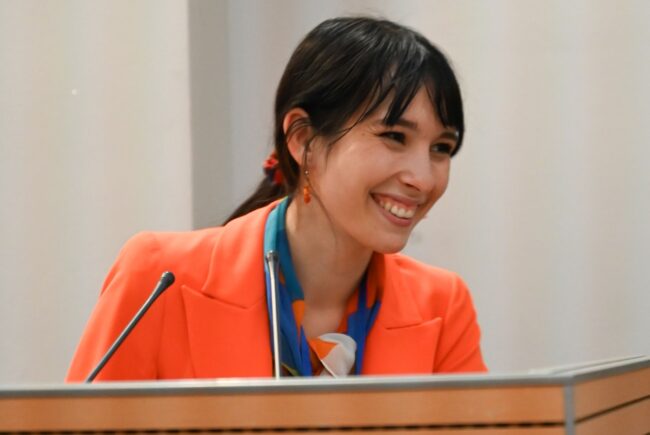
“Policies influence adult education across all sectors,” says Lana Konstantinović. “As an andragogist, I want to contribute to meaningful change within Serbia’s system, especially in areas where adult education can have real impact.” Photo: University of Belgrad.
“Policies influence adult education across all sectors,” says Lana Konstantinović. “As an andragogist, I want to contribute to meaningful change within Serbia’s system, especially in areas where adult education can have real impact.” Photo: University of Belgrad.
“Adult educators must be able to analyse concepts and defend their views,” says Lana Konstantinović, a master’s student at the University of Belgrade. She emphasises that real educational progress also requires patience. “Young Voices” is a new series highlighting the perspectives of the next generation shaping adult education across Europe.
Her journey into adult education began with a love for psychology and scientific inquiry, which grew into a passion for understanding how adults learn and adapt in a changing world. Today, Lana Konstantinović, a master’s student at the University of Belgrade, focuses on vocational training and educational policy, recognising that policies are powerful forces shaping everyday life and learning opportunities.
I completed my bachelor’s studies in Andragogy (Adult Education Science) at the Faculty of Philosophy, University of Belgrade. I am currently pursuing a master’s degree in Comparative Andragogy at the same faculty.
I work at the Chamber of Commerce and Industry of Serbia, in the sector for dual education, work-based learning. I am also engaged at the University of Belgrade as a junior teaching assistant in the International Policies in Adult Education course.
Like many students drawn to the field of education, my initial interest was in psychology. During high school, I attended psychology seminars at the Petnica Research Center, a Serbian nonprofit organisation for formal and informal science education. There I fell in love with academic and scientific writing, but perhaps even more with the experience of being part of a scientific community: teamwork, peer learning and teaching, mutual motivation and creating lasting friendships through shared intellectual curiosity.
Due to the competitiveness of psychology studies, I enrolled in my second-choice programme – andragogy – which I had discovered at the faculty’s open day. It quickly became clear that andragogy offered everything I was looking for: academic writing, research in social sciences, and foundations in various branches of psychology.
Andragogy offered everything I was looking for: research in the social sciences and foundations in psychology.
But it also opened new horizons: creativity through educational games, acting, art in adult education as well as themes of ecology and active citizenship. Curiosity and a love for learning have always shaped me, so I knew I needed a field that was diverse, dynamic and intellectually stimulating. Once I enrolled in andragogy, I never looked back.
Andragogy does not study only (formal) education, it examines everyday life and the challenges adults face. Although my current position is within a VET-oriented field (Vocational Education and Training), I do not see the mission of an andragogist solely as preparing individuals for the labour market. Even within VET, we constantly encounter the humanistic essence of this science.
In Dual Education, I support high school students in entering companies that provide work-based learning, while also working with companies to help them find motivated learners who could become future employees.
In Serbia, where the Dual Education system is still developing, both students and companies need to be heard, and solutions must be contextualised rather than universal. This understanding naturally leads to the area I am most passionate about: (international) policies in adult education.
Policies shape everyday life, and therefore directly influence adult education across all sectors. Understanding the national context is essential for improving practice. Although we may not always be aware of it, we constantly feel the effects of policy decisions on the quality of our personal and professional lives.
I am most passionate about educational policies, as they shape our everyday life and the education sector.
This became especially clear to me during my Erasmus+ exchange in Würzburg, Germany, where I met participants from across Europe, Africa and Asia. Despite different backgrounds, we discovered striking similarities shaped by shared social and policy conditions.
The experience helped me understand my own context more deeply. It strengthened my desire to contribute to meaningful change within Serbia’s system, especially in areas where adult education can have real impact.
Persistence is essential. Even when education is tailored to learners’ needs, consistent funding and supportive national policies remain crucial. Andragogists are not only educators – we are active members of society. Our role is to understand learners, motivate them to participate, and engage alongside them. This mission requires dedication, patience and long-term commitment.
I am fortunate to work with students, and my goal is to spark their interest in Adult Education by sharing stories of international collaboration and concrete examples of how educational policies function “in practice”.
My professor inspired me through examples from her own experience; I remember thinking, “Imagine travelling to so many diverse countries as an adult educator – that would be a dream!”
So far, my own path has taken me to Cyprus, Sweden, Belgium and Germany, working on projects related to sustainability, democracy, and Just Transition. Sharing these experiences helps younger generations see adult education as a vibrant field–one in which you grow as you learn, and you learn through feeling, connecting with others and actively doing.
Critical thinking, although often overused as a buzzword, remains fundamental. Adult educators must be able to deeply analyse concepts, articulate and defend their views, and confidently participate in discussions that shape change.
Adult educators must defend their views and participate in discussions that shape change.
Equally important is patience. Real educational progress takes time. Policy-level improvements follow a long path of experimentation, and individual-level development within learners requires continuous support.
In a world accustomed to “quick fixes,” genuine transformation is a tectonic process. Adult educators must stay motivated, keep experimenting, collaborate widely and remain lifelong learners themselves.
Most people already understand the value of adult education. They simply don’t recognise it as such. Adult education shapes every aspect of adult life: gaining new life roles, becoming parents, entering or changing employment, developing as community members, adapting to sustainability demands, digitalisation, political shifts or financial challenges, for example.
Learning happens not only in formal settings, but also through hobbies, social interactions, books and lived experience. Adult education helps us adapt but also transform.
The ELM series “Young Voices” highlights the perspectives of the next generation shaping adult education across Europe.