
Learning & teaching

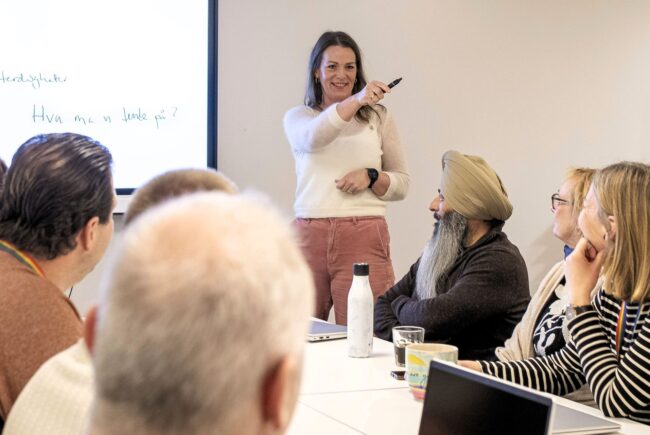
“The project was initiated at the frontline level, but we have succeeded in elevating these issues to the directorate level and to decision-makers,” says Gudrun Totland Raddatz, project manager of the Norwegian Labour and Welfare Administration. Photo: Thomas Knutzen.
“The project was initiated at the frontline level, but we have succeeded in elevating these issues to the directorate level and to decision-makers,” says Gudrun Totland Raddatz, project manager of the Norwegian Labour and Welfare Administration. Photo: Thomas Knutzen.
Gudrun Totland Raddatz from the Norwegian Labour and Welfare Administration discusses a competency package developed for the employees to help combat digital exclusion among residents.
The objective of the training is to enhance the competences of employees at the Norwegian Labour and Welfare Administration (Nav) in providing tailored support to residents who lack the skills to use digital solutions independently. This issue is especially prominent among individuals with limited education and low proficiency in Norwegian.

“The competence package helps our career advisors to learn how to support residents with low digital skills,” says Gudrun Totland Raddatz, project manager at Nav. Photo: Rebecca Zeller.
The competency package helps to assess residents’ digital skills and what the advisors should do based on the mapped skills. The career advisors should be able to know if the resident can benefit from a course in digital skills or some other type of assistance, or whether the advisors can provide some guidance themselves.
The advisors’ enhanced competences will result in improved quality as well as ensure consistent assistance of vulnerable residents. All in all, this is about tackling digital exclusion.
We managed to draw attention to the challenges associated with digital exclusion. A few years ago, during the public sector’s digitalisation drive, services were so focused on transitioning all citizens to digital platforms that we failed to see these challenges.
This project was initiated at the frontline level, but we have succeeded in elevating these issues to the directorate level and to decision-makers. The processes take time, but we have managed to highlight the need for better solutions for those citizens who are excluded and find themselves in vulnerable situations.
One of the most challenging aspects of the project was establishing ownership and getting in touch with the right people in the organisation. As Nav is a large organisation with approximately 22,000 employees, working on innovative projects is demanding.
Daily operations and legally mandated tasks must be prioritised in the day-to-day work at local Nav offices. Additionally, decision-making authority and determinations about what should be prioritised often rest at a much higher level within the organisation.
Additionally, Nav employees have a heavy workload, and implementing new ways of working can be challenging.
The most rewarding aspect has been witnessing a growing awareness of digital exclusion within Nav. Seeing our work contribute to a broader understanding of this issue, not just at the frontline level but also at higher decision-making levels, has been fulfilling. It’s satisfying to know that our efforts are helping vulnerable residents to access essential services and improve their quality of life.
It’s satisfying to know that we help vulnerable residents to access essential services.
What worries me the most, however, is the risk that digital exclusion might continue to be overlooked in the face of other organisational priorities. Nav employees are already overburdened, and implementing new solutions or practices can be challenging when day-to-day operations demand so much attention. There is a concern that without sustained focus, the progress we’ve made could stagnate.
The biggest surprise has been the widespread recognition and support the project received once we managed to elevate the issue to the right level.
Initially, we anticipated limited interest, as digital skills are often perceived as a personal responsibility.
However, we found that many decision-makers were not only aware of the problem, but also eager to find solutions once they understood the scope of the issue. This level of engagement has been a positive surprise.
Our wildest wish is to see the competency package fully integrated into Nav’s standard training across all offices, ensuring that every employee is equipped to support residents with low digital skills.
We also hope to see the development of additional tools and resources that further enhance digital inclusion, ultimately making it a natural part of Nav’s mission.
We wish to see the competency package fully integrated into Nav’s standard training.
Our worst fear is that the issue of digital exclusion will lose momentum and become sidelined due to other pressing organisational demands. If that happens, residents with low digital skills will remain at risk of being excluded from essential services, deepening social inequality and preventing full participation in society.

This article is part of the theme 'Flexible Learning Approaches 2025'.
Read related articles here