Learning & teaching

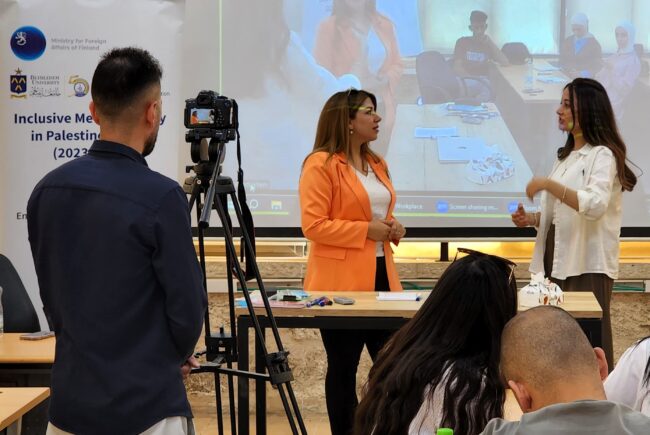
Teacher Tamara Abu Laban (center) sees the course, organised in collaboration with an international partner, as a valuable opportunity for students to broaden their perspectives. “As we Palestinians are often overwhelmed by our situation, we sometimes do not look at other parts of the world,” she says. Photo: Ossayd Alamarneh.
Teacher Tamara Abu Laban (center) sees the course, organised in collaboration with an international partner, as a valuable opportunity for students to broaden their perspectives. “As we Palestinians are often overwhelmed by our situation, we sometimes do not look at other parts of the world,” she says. Photo: Ossayd Alamarneh.
Teaching fact-checking and digital safety is important. The media literacy course organized by Bethlehem University and the Kvs Foundation goes further, fostering active citizenship and strengthening democracy in Palestine. Teacher Tamara Abu Laban and student Natali Nasser Abuayyash share their experiences.
This is a hectic time for documentary filmmaker and Bethlehem University lecturer Tamara Abu Laban. The new semester has just started, which in itself means plenty of work for the teachers. On top of that, in the West Bank the semester comes with a set of challenges.
“We have students who cannot get into the university due to checkpoints and economic difficulties. The registration for the university was postponed this year because many Palestinians struggle to pay the tuition,” she says.
Despite the difficulties, Abu Laban is happy to be back at the university. The programme she teaches in, Interactive Media and Communication, has a record number of participants this year: 35.
“Before, our programme was new, but now more and more people know about it. This is our fourth year as a major; previously it was a minor programme at our university,” she explains.
One of the subjects Abu Laban teaches is media literacy, a topic whose importance cannot be downplayed in this day and age. As social media algorithms create echo chambers of like-minded people and the advancement of AI makes it more difficult than ever to distinguish real information and images from fake ones, media literacy is the skill that enables people to analyse and critically evaluate media content.
At the university, media literacy is included in several courses, and since 2023, there has also been a course dedicated entirely to it. This course is taught in cooperation with the Finnish Kvs Foundation. In this project, Bethlehem University teachers collaborate with Finnish journalists who share their expertise on media literacy and provide insights into the Finnish media system. Since 2024, the course has been organized in a hybrid mode, with Finnish journalists teaching online from Finland.

In addition to lectures, the course offers a variety of exercises and activities. In 2024, instructor Hisham Mellhemallaham led one of these exercises in class. Photo: Ossayd Alamarneh.
“I find it nice to work with people who are from another part of the world. It is interesting to hear the Finnish perspective on media effects and regulations. Because we Palestinians are often overwhelmed by our situation, we sometimes do not look at other parts of the world, and this course is a good opportunity to do that,” Abu Laban says.
Abu Laban has been a teacher in the collaborative media literacy courses since they began in 2023. However, the cooperation between Kvs Foundation and various actors in Palestine on the topic of media literacy started before that. This year marks the tenth year of the projects.
During these ten years, media literacy courses have been organised in many parts of the West Bank, and remote learning opportunities have been provided to people in Gaza. The first project, running from 2015 to 2016, trained 272 Palestinian media professionals and communicators on the topic. After that, the focus shifted to training active citizens, and later to students. Teaching materials on media literacy have been developed and published in English and Arabic. The blog “Kahden kansan välissä” (“Between Two Nations”) has served as an outlet for Finnish volunteers to share their experiences in the project.
The aim of the projects has been to promote the population’s right to information in the region and to strengthen the conditions for civil society and democracy. Although this is a big task, Abu Laban believes that the courses have advanced this goal.
“The students have become stronger in leading different groups in their communities. They trust themselves more and dream bigger,” she says.
The students trust themselves more and dream bigger.
“When we give students the space to implement their own initiatives, we practice democracy. When the students go to different communities and ask what they want and need, they empower civil society.”
As noted by Abu Laban, the university’s media literacy course is only one part of the current programme. Another part is a community project that the students plan and carry out. The media literacy course is taught to third-year media students in the autumn, after which the students teach media literacy in various communities in the West Bank.
The community projects’ target audiences have ranged from children and teenagers to elders. The students have even travelled to more dangerous areas, such as Area C, where Israel retains full civil and security control. These places face, for example, settler attacks, Abu Laban explains.
In one of the projects in Area C, the students taught media literacy to women working in agriculture. The group hiked and played games with the women. This trip was one of the many that Abu Laban remembers fondly.
“The women usually prepare breakfast for their community, but this time we did it for them. They were really happy about it and enjoyed our time together.”
Natali Nasser Abuayyash, 22, is a fourth-year student in the Interactive Media and Communication programme. The fourth year is the final year of bachelor’s studies at Bethlehem University.
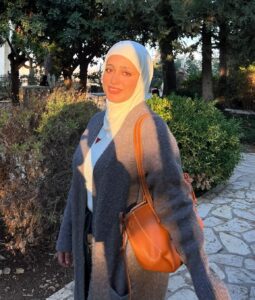
In her future career as a journalist, Natali Nasser Abuayyash wants to give voice to Palestinians. “People are killed, and the occupation and checkpoints affect mental health. I want to show this so people understand us,” she says.
Although finalising her studies can be time-consuming, Abuayyash also finds time to work. She is employed as a social media and marketing manager for a local women’s society that focuses on cooking. Soon, she may work as a TV presenter for Bethlehem’s local radio and TV channel.
Last year, Abuayyash took part in the media literacy course and a community project. She did not know much about media literacy before the course but now has more knowledge of it.
“I was surprised that even now, with the internet and the ability to check information, photos and news can still be fabricated. And that there are people who believe them. It was surprising that people act as journalists without professionalism.”
The community project that Abuayyash and her group carried out focused on digital safety. The group travelled to an area near the city of Hebron, where they taught children, teenagers and students how to protect themselves online. They also prepared an informative video about digital security (in Arabic), a brochure and a poster.
“It was a wonderful experience. Children and teenagers were especially interested in how to ensure that links are safe.”
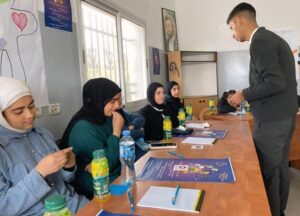
Natali Nasser Abuayyash and her group carried out a community project focused on digital safety near the city of Hebron in 2024. “Children and teenagers were especially interested in how to ensure that links are safe,” she says.
Abuayyash believes that Palestinians currently do not have enough information on media literacy. She hopes that the topic can reach wider audiences. For example, media literacy is not yet part of the Palestinian school curriculum.
“I hope children will learn it in schools in the future.”
Abuayyash dreams of becoming a journalist at a reputable media outlet, such as Al Jazeera. Coincidentally, the reason she applied to the media programme is connected to media literacy: she wishes to correct misinformation about Palestine and give a voice to Palestinians.
“Our story is not clear to people in other countries. People think we fabricate news. But we do not have a nice reality. People are killed, and the occupation and checkpoints affect mental health. It is hard to be a normal person here. I want to show this so people understand us.”
Tamara Abu Laban, a teacher, filmmaker, and mother of three, has depicted the Palestinian reality in her work. During the summer break, she worked on her newest documentary film about a woman born in Bethlehem. It will be aired on the BBC around Christmas 2025.
“You never stop being a journalist once you become one. It is in your blood. I think being in the field helps my students, as everything changes so quickly and it is important to stay up to date.”
The media literacy course and the community project may have provided participants with useful information, but that may not be their only takeaway. Abuayyash echoes the same point that Abu Laban made: the course made her more confident.
“I am more confident now because I have more information. I can now tell other people about media literacy with a clear voice.”
Editor’s notes:
ELM Magazine is published by Kvs Foundation.
The writer worked as a volunteer trainer in the media literacy course organised in September 2025.

This article is part of the theme 'Adult Education and Democracy 2025'.
Read related articles here