Learning & teaching

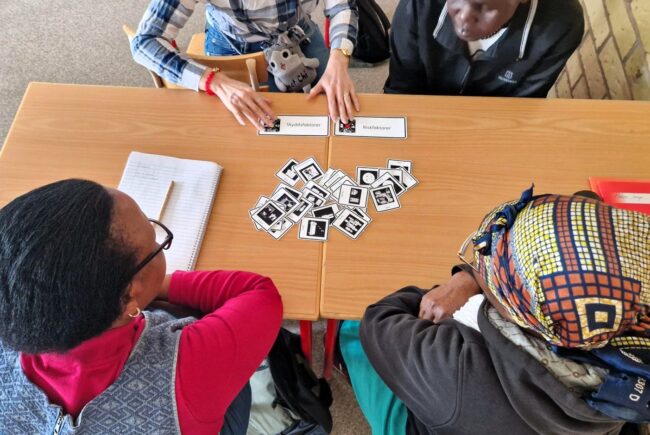
“The themes offered in the model’s resource bank encourage discussions on rights and responsibilities”, says Liliana Melén from the Hagfors municipality. “Women participate more actively in discussions; their voices are heard more clearly.” Photo: Liliana Melén.
“The themes offered in the model’s resource bank encourage discussions on rights and responsibilities”, says Liliana Melén from the Hagfors municipality. “Women participate more actively in discussions; their voices are heard more clearly.” Photo: Liliana Melén.
Teachers working with immigrants and other learners in Sweden report major improvements in classroom discussions about values and rights, thanks to an innovative programme developed by the National Agency for Education and the Living History Forum.
Sweden has been developing the “Democracy Step by Step” research-based model for democracy education since 2021. That’s when the government asked the National Agency for Education and the Living History Forum to come up with a systematic approach to work on democracy and human rights within schools.
“The model covers both a learning climate based on democratic principles and human rights values as well as opportunities for learners to develop democratic competences such as values, attitudes, skills and knowledge for active democratic citizenship,” explains Hugo Wester, Director of Education at the Swedish National Agency for Education.
In early 2024, the model was formally launched in two versions, one for schools, from primary through adult education, and another one for independent adult colleges and folk high schools. Since then, it has also been adapted for adult educational associations, preschools and schools for pupils with intellectual disabilities and special needs.
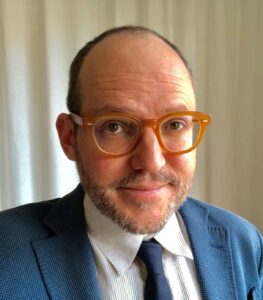
“The model fosters a learning climate based on democratic principles and human rights, while building key skills for active citizenship,” says Hugo Wester. Photo: Hugo Wester.
Wester notes that the Nordic countries face challenges in these areas during this era of polarisation and radicalisation, erosion of trust in politics and democratic institutions, misinformation and growing uncertainty about conflicts and war.
“In schools and among young Swedes, we see a worrying lack of equality in democratic competences and attitudes towards democracy and fundamental rights,” says Wester. “Also, the school climate is not sufficiently characterised by safe classrooms, trustful relations, participation and belonging. Bullying rates are increasing as well as psychological health problems. These affect equal opportunities for all learners to learn.”
Democracy Step by Step was inspired by the Norwegian Dembra model, which was developed in 2016 with the aim of combating antisemitism, racism, extremism and other undemocratic attitudes, as well as the Council of Europe’s Framework of Competences for Democratic Culture, which started with an initiative from Andorra in 2013. The Swedish government has provided nearly a million euros in funding for the project via two national agencies since 2022.
Since 2024, the model has been adopted by more than 50 schools with another 20 due to start soon. One of the institutions involved in the early pilot phase, beginning in 2022, was Västerbottens Folk High School, a regional adult education network with campuses across northern Sweden.
According to Ingiberg Olafsson, one of the school’s teachers, the model gave them a structure to reflect, involve others and translate democratic values into daily practice at their school.
“My impression is that the model works, not because it adds something completely new, but because it makes democracy visible and deliberate. It helps you take what often happens informally in a folk high school – participation, dialogue, influence – and turn it into a conscious process that deepens understanding and engagement.”

“Students value discussing how we talk – when dialogue itself becomes part of learning. That’s when democracy is lived, not just discussed,” says Ingiberg Olafsson. Photo: Ingiberg Olafsson.
Olafsson says that Democracy Step by Step spurred the school to create its own ‘Democratic Conversations’ model, which helps teachers to lead open and reflective classroom discussions.
“We also involved students in mapping out how they experience influence and participation in school life, and used that feedback to guide our work,” he says. “In practice, that means rethinking how we talk, how we make decisions together, and how we handle complex or controversial topics in teaching.” So far, some 150 students have been involved in the process, ranging in age from 18 to 75.
Their response has been “very positive, with many reporting that they feel more seen and listened to, and that the school feels more like a community where everyone’s voice matters,” says Olafsson. “They also appreciate it when we take time to talk about how we talk – that is, when dialogue itself becomes part of the learning process. It’s often in those moments that democracy becomes something lived, rather than just discussed.”
Any surprises in the process? It was “a pleasant surprise” to see how quickly teachers and students embraced the idea of working systematically with democracy, he replies.
“The process made many invisible things visible – how influence actually works, how decisions are made, and what inclusion really means. We’ve seen clearer communication, stronger group cohesion, and a more reflective atmosphere in the classrooms,” he notes. Meanwhile, instructors report that students have become more confident in expressing opinions and listening to others.
Liliana Melén has had parallel experiences as a teacher and development manager for Swedish for Immigrants (SFI) in Hagfors municipality, located in the Värmland region of west-central Sweden. The municipality has been exploring the Democracy Step by Step model since early 2024. So far, she says, the general impression is “very positive”.
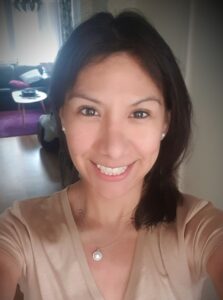
“Thanks to the model, teachers feel more confident addressing controversial topics after exploring tools and materials together,” says Liliana Melén. Photo: Liliana Melén.
Melén, too, has been positively surprised by how the model has influenced classroom dynamics.
“Participation is more equal and inclusive. In particular, women participate more actively in discussions. Their voices are heard more clearly, and they express a desire to share their thoughts and experiences with others,” says Melén.
“The conversational climate has become more democratic. Students show greater respect for each other’s opinions, even when they differ from their own, and they practice collaboration and compromise in various exercises. Discussions are increasingly characterised by openness, curiosity and shared responsibility for the conversation.” Overall, she says, the project has contributed to a more reflective, respectful and inclusive learning environment.
Around 40 SFI students have participated in the work so far, ranging in age from 20 to 60. They come from countries such as Syria, Sudan, Ukraine, Tanzania and Somalia, contributing to a rich exchange of experiences.
Democracy Step by Step, she says, has provided teachers with a concrete, inspiring tool to work with democratic values, participation and human rights in a way that promotes both language development and knowledge acquisition. In Melén’s view, “the model has also encouraged reflection on gender equality, influence and cultural diversity in the classroom.”
The model encourages reflection on gender equality and cultural diversity in the classroom.
How, then, is the model applied in practical terms?
“We use it in group discussions, role-playing and reflection tasks on democracy, equality and societal participation. Teachers have also linked the material to themes such as working life, gender equality, children’s rights and individual responsibility in society,” she replies.
Many of the participants feel they have gained a deeper understanding of how democracy functions in practice in Sweden and feel more engaged in societal issues, reports Melén. “Classroom discussions have often sparked strong engagement and helped participants feel more confident in expressing their opinions and reflecting on their own experiences.”
Teachers, too, have highlighted positive impacts, saying that the model has provided a clearer holistic perspective on students’ needs and how teaching can be planned to meet them.
“They feel more confident in addressing controversial and value-laden topics, as they’ve had time to explore tools and materials together using the resource bank, she says.
Democracy Step by Step has also been used as a discussion framework within the teaching team during joint planning. That strengthens collegial learning, shared reflections and the structure of instruction.
Melén believes that the concept could “absolutely” be adapted to municipalities anywhere in the world.
“With minor adjustments, the model could be used in many different contexts, especially in adult education and integration,” she says, pointing out that, in particular, language instruction and work with democratic values can reinforce each other.
Language instruction and work with democratic values reinforce each other.
Olafsson agrees, pointing out that “the foundation of the model – that democracy is strengthened through everyday dialogue and shared reflection – is universal. It’s less about Swedish conditions and more about human ones. As long as a school is willing to include both staff and learners in an open process, the model would fit almost anywhere,” he says.
“The process is valuable in that it involves everyone: leadership, staff and students. So democracy becomes something the whole school takes responsibility for,” says Olafsson.
According to Melén, the most useful part of the project is the extensive material in the resource bank. She says that it’s easy to adapt to different levels, groups and needs and is therefore useful in adult education.
“The resource bank offers a wide range of current and relevant themes that engage participants and create natural conversations about values, rights and responsibilities. It also serves as support for teachers who can use it as a basis for joint planning, reflection and collegial discussions. In this way, the project contributes to both participants’ learning and teachers’ professional development.”
Both Melén and Olafsson see room for improvement and fine-tuning of the model.
“One area that still needs development is the adaptation of the resource bank material to different language levels,” says Melén. “Although the material is flexible and can be used in various contexts, teachers often need to modify the content to make it more accessible for participants at different levels.”
For example, this may involve simplifying texts, adding visual aids or creating easy-to-read versions of reflection questions and exercises. As a result, some teachers may find it challenging to adapt the material to the extent needed, she says.
As Olafsson sees it, “the next step should be about how to make democratic learning visible – not through assessment or grading, but through reflection and dialogue. It would also be interesting to see how the model could evolve in digital and hybrid settings, where participation works a bit differently. Finally, I think it’s worth exploring how students can take an even more active role in shaping the process from start to finish” – emphasising democracy at the classroom level.

This article is part of the theme 'Adult Education and Democracy 2025'.
Read related articles here