Learning & teaching


As more people drift towards the political extremes, is purposeful dialogue still possible? Should adult educators refuse to engage with those they see as enemies of democracy, or should they open up channels for dialogue in the hope of fostering mutual understanding? Photo: Anne Nygard on Unsplash.
As more people drift towards the political extremes, is purposeful dialogue still possible? Should adult educators refuse to engage with those they see as enemies of democracy, or should they open up channels for dialogue in the hope of fostering mutual understanding? Photo: Anne Nygard on Unsplash.
With polarisation on the rise, is meaningful dialogue across divides still possible? Political scientist Richard Gebhardt and psychologist Marina Weisband explore the issue from a German perspective.
Literally meaning “the rule of the people”, democracy has its roots in the 5th century BCE. But over the past hundred years, it’s become one of the cornerstones of European society – a response to the horrors of the World Wars and a foundation for modern life. It once stood for mutual respect, participation and equality. But is that still true in 2025?
At the start of the year 2025, US Vice President JD Vance accused European governments of turning their backs on democratic values and ignoring voters’ concerns on issues like migration and free speech. His comments sparked a heated debate, not just about what democracy means, but about who gets to define it.
As our societies become increasingly fragmented and polarised, democratic debate and dialogue seem to be growing more difficult, with people often struggling to find common ground.
Before resigning in August 2025, Germany’s former Vice Chancellor, Robert Habeck, suggested that the country’s centrist parties are no longer able to hold back the rise of the far right, including the Alternative for Germany (AfD), which has become the most popular party in the country (RTL/ntv Trendbarometer). His remarks added fuel to the growing belief that the political centre is vanishing across Europe, with society drifting towards the extremes – left or right – and leaving little space for dialogue or compromise.
In a world that’s becoming ever more divided, with disinformation and malinformation on the rise and prominent political and social media figures defending their right to free speech, even when sharing racist, misogynistic or offensive views, the question looms large: is democracy under threat?
Experts are grappling with a familiar dilemma that’s gained renewed urgency in recent years: should democracies build walls against those they consider as “enemies”, or should they open up channels for dialogue in the hope of fostering mutual understanding?
We spoke to two leading voices in adult education and lifelong learning in Germany: Richard Gebhardt, a political scientist and head of the NRWeltoffen project at the adult education centre (VHS) in Aachen and Marina Weisband, a psychologist and expert in participatory education who leads the aula project.
“It feels like we’re dealing with two competing versions of democracy in our societies,” says Gebhardt. “Both claim to stand for democratic values: one side champions anti-racism and inclusion, while the other defends freedom of speech. But is it truly democratic when that freedom is used to spread racist, homophobic or misogynistic views?” he continues.
“The truth is, there are actually three different ideas people have in mind when they talk about democracy,” says Weisband. She goes on to explain that the first is institutional knowledge, or the understanding of how democratic institutions function. The second is education in democratic values, such as tolerance and opposition to antisemitism. And finally, “the real heart of democracy is socialisation into democratic rule. That means people recognising their role in society. Many are not aware of this. We’re often told what to do, but when do we actually act as engaged citizens, exercising our democratic rights and responsibilities?” she asks.
When do we actually act as engaged citizens, exercising our democratic rights?
That’s how Weisband came up with the idea for the aula project, a participatory initiative that’s been running for ten years and gives young students a say in everyday decisions at school. Aula offers an app and educational resources that help pupils voice their ideas and turn them into real projects.
“More than 50 schools in Germany and abroad have adopted the programme, which now has over 170 ambassadors and several tangible successes under its belt: from introducing menstrual products in schools, to using smartphones for learning and even organising international dance festivals,” says Weisband.
“This project is built around the idea of self-efficacy: the belief that when someone takes action, it can lead to real change,” Weisband explains.
The concept stems from the reality that in today’s world people are more informed than ever about the many crises we face – from climate change to wars in Ukraine, the Middle East and Sudan, to name just a few.
“We know everything, but we can’t change anything and that is my personal idea of hell,” she says.
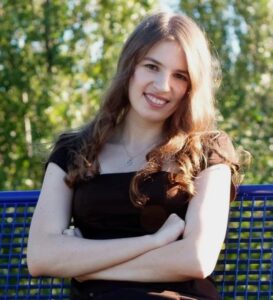
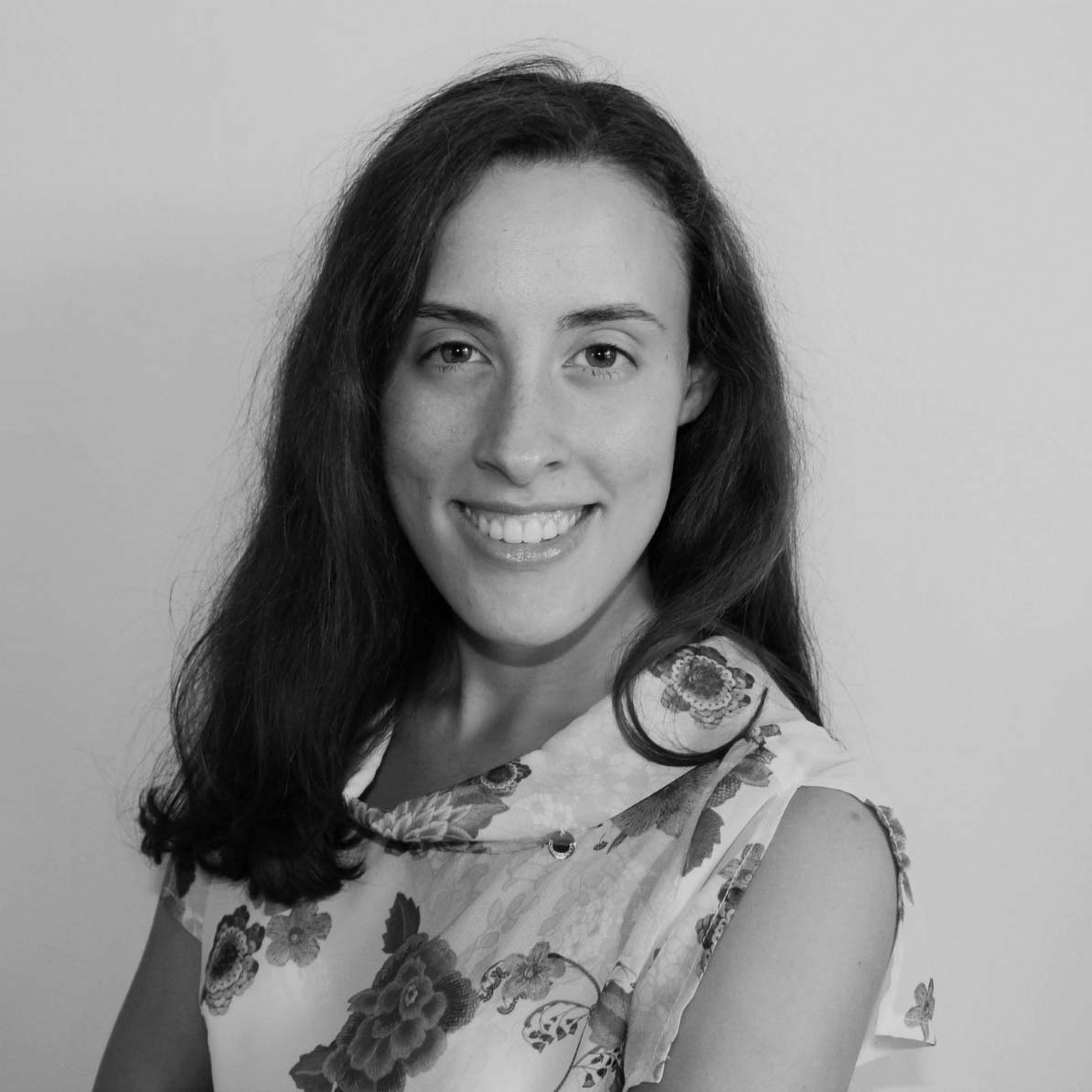
“My aim was for the next generation to grow up not as passive visitors or consumers but as creators,” Marina Weisband says. Photo: Marina Weisband.
Her argument is that this constant exposure to global problems can leave people feeling helpless and powerless, with their sense of self-efficacy at an all-time low.
“When people feel they have no control over a complex world, it becomes easier to fall for populist and propagandist narratives. That’s one reason why far-right movements are growing so quickly, because they offer simple answers to complicated issues and give people a sense of control.”
Weisband explains that academic studies on the aula project have shown that self-efficacy among students increased by more than 70% over two years. Social cohesion also improved, and incidents of vandalism in schools went down.
“My aim was for the next generation to grow up not as passive visitors or consumers, but as creators,” Weisband says.
The project has earned Weisband and her team significant recognition over the years, including a recent €3,000 prize from the German Didacta, the trade fair for all things education.
“I was named Education Ambassador for 2025, which I’m genuinely honoured by. But since the AfD was one of the main exhibitors at the fair, I chose to reject the award,” says Weisband.
When asked whether, in her view, what she calls “anti-democratic” actors should be present at events like this, Weisband took a clear stance: “No, they shouldn’t. I’m truly saddened to have turned down such a prestigious award, but I feel like fascism is being normalised more and more each day, and I don’t believe we can have a meaningful conversation with those kinds of political views.”
This is why Weisband refuses to take part in political or televised debates with members of the far-right AfD.
“I believe in dialogue and debate but what the AfD is doing is undermining both. They’re using democratic tools, like freedom of speech, to actively dismantle democracy. That’s why I don’t support engaging in dialogue with them,” she explains.
“German democracy” – she continues – “is quite unique in that it recognises democracy not just as a right, but also as a responsibility. People have a duty to protect it from those who exploit democratic mechanisms to destroy it.”
One example she points to is freedom of speech, a right that some say is being eroded in Europe.
“The truth is the right to free speech ends when it’s used to attack democracy itself. I don’t believe we should engage with people who are abusing democracy rather than genuinely participating in it.”
“On a theoretical level, dialogue with people who lean toward the extreme right is essential in our society, but in practice, it’s almost impossible. That’s the contradiction and the challenge,” says Gebhardt.
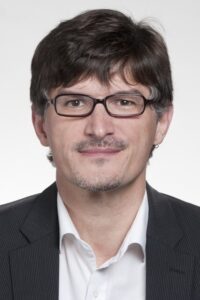
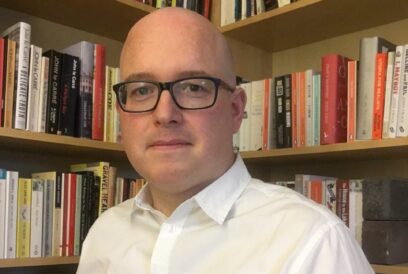
“Our role as educators is to create spaces where opinions can be voiced without fear of judgement or censorship,” Richard Gebhardt says. Photo: Richard Gebhardt.
Alongside his work in adult education, he’s also active as an education worker in the labour union, where more and more members are leaning towards the AfD.
“We obviously need to engage with our union members; shutting down dialogue isn’t an option. But it’s becoming increasingly difficult,” he adds.
Despite advocating for dialogue, Gebhardt admits that genuine conversation and mutual understanding have become increasingly difficult in recent years, especially since the Covid pandemic.
“During that time, we began to notice a surge in misinformation, and we even issued a statement with our city administration condemning the many conspiracy theories that were circulating in our town,” he explains.
The Mayor of the City of Aachen and the VHS also organised online meetings and forums to address people’s concerns about the government’s handling of the pandemic and the vaccine rollout.
“Sadly, that was when I realised that, with some people, dialogue just isn’t possible. Especially those promoting conspiracy theories. I’d never before experienced a situation where we simply weren’t speaking the same language. There was no common ground. Whatever argument I put forward, the only response I got was that it was all fake,” says Gebhardt.
Shutting down dialogue isn’t an option. But it’s becoming increasingly difficult.
The compromise Gebhardt has found is to combine confrontation with dialogue.
“As civic educators, we must be above party politics but that doesn’t mean we can be neutral,” he says, adding that he always tries to understand who he’s speaking to before choosing his approach.
“If I’m talking to someone who’s clearly a conspiracy theorist, who isn’t interested in finding common ground and is essentially an enemy of democracy, then I use confrontation: I state the facts and challenge their misinformation. But if it’s someone who’s genuinely concerned and open to discussion, then I’ll engage in dialogue.”
Gebhardt believes it’s crucial to offer people spaces where they feel heard and where conversation is possible.
“It’s important that people have room to express their views and perspectives. Our role as educators is to create spaces where opinions can be voiced without fear of judgement or censorship. The challenge is that people’s emotions are often deeply tied to their politics and it’s incredibly difficult to reason with someone when the conversation is so emotionally charged.”
Weisband agrees, noting that “you can’t reason your way out of emotions. But emotions can actually be a good starting point for dialogue.”
She adds, “As I’ve said before, I don’t appear on talk shows with AfD members, but I do speak with people in my life who vote for them, and I try to connect with them on an emotional level.”
Weisband is clear about setting boundaries around what she chooses to engage with. She avoids online debates and refuses to enter discussions around racist rhetoric. But she does make space for conversations about people’s fears and concerns.
“For instance, when someone expresses views that might be sexist or racist in the context of feeling unsafe in cities, I try to shift the focus to the shared desire for safety. That way, we find common ground: we both want to feel safe. And that’s how a constructive conversation begins,” she explains.
However, what worries Gebhardt most is the growing inability to find common ground across different parts of society.
“Up until the 1980s, it was much easier to have a conversation with someone who held different political views, there was usually something you could agree on,” he explains.
“Now, it often feels like there’s nothing to connect over, and that’s what makes democratic dialogue so difficult. I was also politicised by the rhetoric of the Cold War. Back then, there were often opposing views, but at least there was a shared vocabulary. But supporters of conspiracy ideologies, for example, operate within a completely different worldview, built on self-created ‘alternative facts’ and with that, entirely different political categories.”
So, where does adult education fit into all this?
“I believe adult education has huge potential to help citizens become more aware of their civic responsibilities,” says Weisband.
“One of its strengths is that the curriculum isn’t as rigid as in traditional schools, which can really spark curiosity among learners. Adult education is more important than ever, and it can make a difference, but it has to be democratic. Learners need to understand both their responsibilities and their ability to bring about change.”
She also emphasises that socialising adults into democratic participation is particularly challenging. “It’s much easier to do this work with young people because adults are harder to reach.”
“The truth is, adult education on its own is no longer enough,” says Gebhardt, who takes a more pessimistic view of the matter. “The difficulty in establishing meaningful dialogue and democratic conversation is part of a much broader issue, one that spans politics, culture and economics. We won’t be able to fix it through adult education alone.”
That said, Gebhardt still believes there are ways to encourage dialogue. “We need to keep sight of the ultimate goal: to have conversations and ensure people have spaces where they can share their perspectives. As adult educators, our role is to provide reliable, unbiased information, but also to listen and learn from the public. We need to be learners ourselves, not come across as snobbish or judgemental, because that’s how we lose people. We must create public spaces where people feel safe to express their concerns and thoughts. I am, of course, aware of the ambivalence of this position.”
Weisband also believes in the importance of creating public spaces for sharing information, though her focus is more on the media.
“One of the key drivers of polarisation, and what’s deepening the divide in our society, is the current business model of the media,” she explains. “We’re seeing billionaires owning media outlets that compete for attention and this attention economy is tearing society apart. As humans, we naturally focus on the dramatic and the tragic – it’s in our nature. So if a media system rewards the most radical, sensational content, the divide only grows. Their job becomes making people angry and that’s not good for democracy or dialogue.”
That’s why she proposes the idea of digital public spaces built on cooperative models: platforms collectively owned by readers, promoting quality journalism and educational content, rather than constant negativity.
“I don’t know if it’s entirely feasible, but I do think there’s a market for it. People need a more democratic way of staying informed. We need change, because simply defending democracy isn’t enough anymore, we need to improve it. I don’t want things to stay as they were yesterday, because yesterday is today. I want things to be like tomorrow,” she concludes.

This article is part of the theme 'Adult Education and Democracy 2025'.
Read related articles here