Learning & teaching


Derry's 'Hands Across the Divide' monument symbolises reconciliation in Northern Ireland. Now that sectarian violence has faded, Derry, an UNESCO Learning City, is combating sexual and domestic violence through adult education. Photo: Visit Derry.
Derry's 'Hands Across the Divide' monument symbolises reconciliation in Northern Ireland. Now that sectarian violence has faded, Derry, an UNESCO Learning City, is combating sexual and domestic violence through adult education. Photo: Visit Derry.
Northern Ireland’s sectarian violence has faded, but the region still suffers from high rates of domestic and sexual violence. While addressing the root causes, Derry supports victims through adult education.
Derry and the neighbouring town of Strabane were among the areas most devastated by Northern Ireland’s bitter ethno-nationalist conflict known as the Troubles. Thousands of people, mostly civilians, were killed between the early 1970s and a 1998 peace agreement.
That brutal legacy still reverberates in Derry (officially known as Londonderry) and in Strabane, which had the grim distinction of being the most bombed town in Europe of its size, while suffering the highest unemployment rate in the industrial world.
In 2019, Derry-Strabane was designated as a UNESCO Learning City, and since 2023 has focused on combating sexual and domestic violence, while supporting its victims through adult education.
“The outward violence has stopped in Northern Ireland, but there’s still a lot of coercive control in communities involving ex-paramilitary and now gang members,” says Marie Brown, CEO of Foyle Women’s Aid and Foyle Family Justice Centre (FFCJ), which is playing a crucial role in breaking the cycle of violence.
“We have high rates of mental health issues, homelessness, violence and homicides as fallout of what we’ve been through here. It’s generational, so there’s a lot of work that needs to be done to change that,” she says.
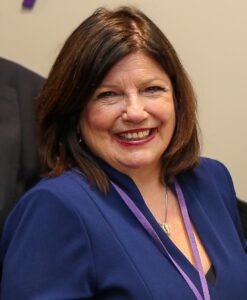
“In our confidence-building classes for victims of abuse, we talk about the barriers they may face and help the women build their self-esteem,” says Marie Brown of the Foyle Family Justice Centre.
Violence against women and girls is pervasive throughout Northern Ireland (NI). According to a July 2025 report by the British Parliament’s Northern Ireland Affairs Committee, 98% of women in NI have experienced at least one form of gender-based violence while 28% of all victim-based crimes in Northern Ireland are related to domestic abuse.
Within a 12-month period in 2023-24, nearly 20,000 domestic abuse crimes were recorded, with a case reported to police every 16 minutes on average. The actual number of cases is likely much higher, as most such crimes are not reported. As NI’s second-largest city, Derry is also severely affected – but there are hopes for improvement.
According to John D’Arcy, Chair of the Alliance for Lifelong Learning and of AONTAS, an adult learning organisation spanning the island of Ireland, “Derry’s designation as a UNESCO Learning City is a strong commitment in the city and surrounding districts to utilise lifelong learning as a way of tackling deep-rooted social challenges, including domestic and gender-based violence,” he says.
In his view, the approach in Derry is noteworthy as it is actively working to break the cycle of violence through education, empowerment and collaboration.
“By embedding learning into recovery and prevention, this Learning City is helping to build a more resilient, informed and compassionate community,” says D’Arcy, who is also Director of the Open University in Ireland.
The approach is actively working to break the cycle of violence through education, empowerment and collaboration.
Derry’s approach covers four strands, starting with education for prevention, he explains.
“This includes teaching children and young people about healthy relationships; training justice system professionals to better support victims and survivors; and running public awareness campaigns.”
Foyle Family Justice Centre is developing a training programme aimed at the root cause, i.e. helping men to change attitudes and find non-violent ways of responding. Brown points to the Northern Ireland branch of the Canada-based White Ribbon Campaign, which engages men and boys to speak up and be involved in tackling violence against women.
“Non-abusive males have a key role in this work and can both tackle misogyny in all its forms and act as positive role models,” she says. “Within our projects, we’ve worked with many boys who’ve been affected by violence against women, either as a witness or a victim themselves. They often feel powerless or suffer if they try to intervene. We are aiming for healthy relationships and other interventions to break the cycle of violence early and to give male victims support.”
Here, too, D’Arcy stresses that “community collaboration is key. Derry works closely with local organisations, law enforcement and support networks to create systematic change.”
Collaboration with local organisations and law enforcement aims to create systematic change.
Indeed, among best practices developed in the area, D’Arcy points to “the collaborative approach across the city, its districts and many organisations,” which he calls “a commendable way of working”.
“Meanwhile, there is support for survivors, i.e. providing skills training and resources to help them rebuild their lives; and offering emergency accommodation, advocacy and care through organisations like Foyle Women’s Aid and the innovative, leading-edge Foyle Family Justice Centre (FFJC).”
Alongside its support and training for victims, the FFJC runs programmes with local employers and officials, helping them understand issues around domestic violence.
The FFJC, which opened in 2022, is the first of its kind in the UK or Ireland: a one-stop hub offering integrated legal, emotional and practical services for survivors. A key component of that is adult education, says Brown.
“We had some funding to create a training academy for women who’ve been out of the workforce because of domestic violence. We worked with the city council and the local polytechnic, North West Regional College, to help the women get some initial qualifications and then place them into workplaces. Nine women got placements across the city, at hotels and a range of places. It’s a small group, but it’s a start. Some of them have gotten jobs and remained in them. One got a full-time job as a teacher’s assistant, so she’s come back to talk to others about that.”
In the spring of 2024, the FFJC opened Café Central, a social-economy business where some abuse survivors work. Profits from the restaurant go to support Women’s Aid programmes.
“They’re not going to work at the café permanently; it’s just giving them that initial expertise,” says Brown. “They’re trained in a range of skills at the café, including customer service.”
One Café Central employee, Mary, recounts her experience in a Learning City of Derry video.
“In the Academy, we learned health and safety, first aid, food hygiene, how to work in hospitality, working with people in the public, things like that. It was brilliant, fantastic.”
She says that she and other Academy participating are “continuing from what we’ve learned in our course and integrating it into our everyday use in the Café, working with people and preparing food.”
“I’m a lifelong learner because no matter what I’ve been through, I like to put a positive attitude on things and bring happiness and hope to other people as well as myself,” Mary adds.
I’m a lifelong learner because no matter what I’ve been through.
The FFJC also offers confidence-building classes for victims of abuse.
“We bring them together in groups to talk about what barriers they may feel, for example not having an education or being from an ethnic background,” says Brown.
“Often women feel that they have nothing to offer, but when you chat with them, you find they’ve had a lot of experience. So it’s getting them to put that experience down on paper, doing CVs and building self-esteem.”
“We have a volunteer programme as well. After the women have been out of crisis for a while, they can come back and volunteer and gain experience, training and skills. We’re setting up a partnership with the University of Ulster, so that will be the next phase,” she says.
“We’re working to further develop our education with the local tech college and the university, in terms of recognising skills, to try and get disenfranchised women or young people into the educational setting. We’ve always done it informally, but it’s good that we have some formal sort of commitment now to recognising this as an issue, and that’s what’s welcome about this Unesco initiative.”